Aging Infrastructure, Shrinking Margins: The Business Cost of a Tech Stack Past Its Prime
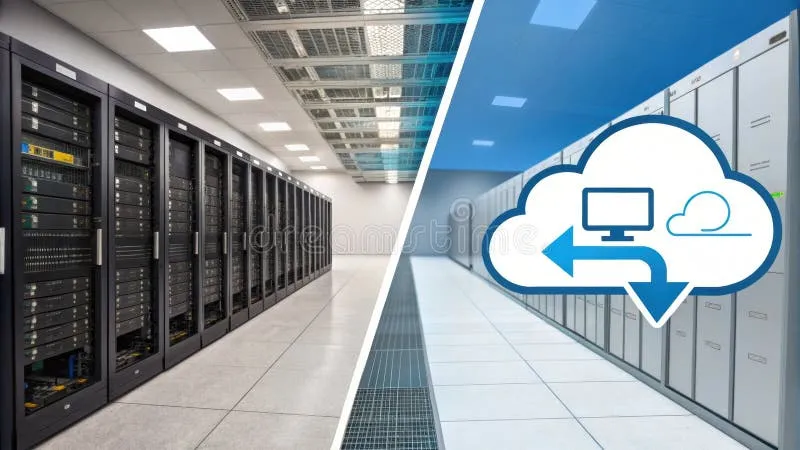
Photo: outdated server room next to modern cloud technology business comparison, via thumbs.dreamstime.com
There is a particular kind of organizational risk that never appears on a balance sheet until it is almost too late to address. It does not announce itself through a system outage or a data breach. Instead, it compounds quietly over months and years, manifesting as slightly slower product launches, marginally higher operational costs, and customer experiences that feel just a fraction behind the competition. That risk is technological debt — and for a significant number of American businesses, it has already become a strategic liability.
The instinct to delay infrastructure upgrades is understandable. Technology modernization projects are expensive, disruptive, and notoriously difficult to scope accurately. When leadership teams weigh the immediate cost of an overhaul against the abstract risk of "falling behind," the default choice is often to defer. But that calculus is fundamentally flawed, because it treats aging infrastructure as a static condition rather than a dynamic drain on resources and opportunity.
What Legacy Systems Actually Cost
The most visible cost of an outdated tech stack is maintenance. According to research from technology advisory firms, large US enterprises spend between 60 and 80 percent of their IT budgets simply maintaining existing systems — leaving a fraction available for innovation or competitive development. For mid-sized businesses, the proportions are often even more punishing.
But maintenance expenditure is only the surface layer. Consider the following categories of hidden cost that rarely appear in a standard technology audit:
Integration friction. Legacy platforms frequently lack native compatibility with modern APIs, cloud services, and third-party productivity tools. Every workaround — every middleware patch, manual data transfer, or custom connector — represents engineering hours diverted from value-generating work.
Talent attrition. Skilled technology professionals increasingly evaluate employers not only on compensation but on the quality of the tools they will be expected to use. Organizations running obsolete systems face measurable disadvantages in recruiting and retaining top engineering, data, and product talent.
Compliance exposure. Regulatory frameworks governing data privacy, financial reporting, and industry-specific standards evolve continuously. Legacy systems that were compliant at deployment may no longer meet current requirements — creating legal and financial exposure that compounds with each passing year.
Speed-to-market penalties. Perhaps the most consequential hidden cost is velocity. Businesses operating on outdated infrastructure simply cannot iterate, test, and deploy new capabilities as rapidly as competitors running modern, cloud-native environments. In markets where product cycles are measured in weeks rather than quarters, that gap is decisive.
Case Studies in Competitive Erosion
The retail sector offers some of the most instructive examples of what happens when infrastructure investment is perpetually deferred. Several regional US retail chains that once held strong market positions discovered, often too late, that their inventory management and e-commerce systems could not support the personalization, real-time fulfillment visibility, and omnichannel capabilities that consumers had come to expect. While competitors built on modern platforms introduced same-day delivery and AI-driven product recommendations, these organizations were still contending with batch-processing systems that updated inventory data overnight.
The outcome was not a single catastrophic failure. It was a gradual erosion — customers migrating to more responsive competitors, conversion rates declining, and marketing investments underperforming because the underlying data infrastructure could not support sophisticated targeting. By the time leadership recognized the technology gap as a strategic issue rather than an IT concern, the cost of modernization had grown substantially and market share had already been surrendered.
The financial services sector tells a parallel story. Community banks and regional credit unions that delayed core system modernization found themselves unable to deliver the mobile-first, real-time account management experiences that fintech challengers offered from day one. The competitive asymmetry was stark: while legacy institutions allocated significant resources to maintaining decades-old core banking platforms, newer entrants built on cloud infrastructure were deploying new features in days.
Distinguishing Manageable Debt from Strategic Liability
Not all technological debt demands immediate action. The challenge for business leaders is developing a disciplined framework for assessing when legacy infrastructure transitions from a manageable constraint to an active threat to competitive positioning.
A useful starting framework examines four dimensions:
1. Integration capacity. Can your current systems connect with the tools, platforms, and data sources your business needs to operate competitively over the next three to five years? If the answer requires extensive custom development or produces unreliable data flows, the debt is material.
2. Scalability headroom. Does your infrastructure support growth without proportional increases in cost or complexity? Systems that require significant manual intervention or custom configuration to accommodate volume increases impose a ceiling on organizational scale.
3. Security posture. Legacy systems frequently run on software versions that no longer receive security patches. The cybersecurity implications alone can justify modernization investment, particularly for organizations handling sensitive customer or financial data.
4. Opportunity cost. This is the most difficult dimension to quantify but often the most important. What capabilities — personalization, automation, real-time analytics, AI integration — are unavailable to your business because your infrastructure cannot support them? Mapping those gaps against competitor capabilities provides a clearer picture of what delayed modernization is actually costing you in market terms.
Building the Case for Modernization
For technology leaders, translating infrastructure concerns into business-level investment decisions requires reframing the conversation. Modernization should not be presented as a technology upgrade — it should be presented as a revenue protection and growth enablement initiative.
Quantifying the cost of inaction is essential. This means documenting engineering hours consumed by legacy system maintenance, calculating the revenue impact of slower product deployment cycles, and modeling the customer lifetime value implications of experience gaps relative to competitors. When these figures are assembled into a coherent business case, the ROI calculation for modernization often looks considerably more favorable than initial capital expenditure estimates suggest.
Phased modernization approaches also deserve serious consideration. Rather than attempting a wholesale platform replacement — with its attendant risk and disruption — many organizations achieve meaningful competitive improvement through targeted modernization of the highest-impact systems first. Prioritizing the infrastructure that directly affects customer experience, data accessibility, and product delivery velocity typically generates measurable returns that build organizational confidence for subsequent phases.
The Window for Action
One of the more counterintuitive dynamics of technology-driven competitive markets is that the cost of modernization does not decrease over time — it increases. As legacy systems age further, the pool of professionals with relevant expertise shrinks, integration complexity grows, and the capability gap relative to competitors widens. Organizations that act while their competitive position is still intact have substantially more strategic flexibility than those that wait until the pressure is acute.
The businesses that will define their sectors over the next decade are not necessarily those with the largest technology budgets. They are the ones that recognize infrastructure as a strategic asset rather than a cost center, and that invest in modernization with the same discipline they apply to market development or talent acquisition. For US businesses navigating an increasingly technology-driven competitive landscape, the question is no longer whether to modernize — it is whether the organization will lead that transition or be compelled by competitive pressure to follow.